You’ve probably seen this before. A machine gets installed, sitting on cheap rubber pads because that’s what everyone uses. Six months later, the pads have gone hard and flat, the machine is vibrating more than the day it was installed, and someone’s writing a purchase order to replace them again.
So here’s the real question: rubber pads and wire rope isolators are both sold as vibration isolators, so why does one cost ₹200 and the other ₹2,000? Are you paying ten times more for the same job, or are you actually buying something different?
By the time you finish reading this, you’ll know exactly which one fits your machine, and more importantly, what to ask your supplier before you place the order.
First, What Does an Isolator Actually Do?
Strip away the technical talk and it’s simple. An isolator is a cushion between your machine and whatever it’s sitting on, whether that’s a floor, a frame, a truck bed, or a panel wall. Its job is to stop the shaking from one side reaching the other.
Now there are two different problems an isolator might need to solve.
Vibration is the constant, low level shaking a machine makes while it’s running. Think of a motor humming all day.
Shock is a sudden, hard jolt. Think of a press coming down, a truck hitting a pothole, or a crate getting dropped during loading.
Here’s the part most people miss. A product that’s great at one of these can be pretty bad at the other. That’s really the whole story of rubber versus wire rope.
Think of it like the difference between a sofa cushion and a car’s suspension. A cushion is great when you sit down gently. It’s useless when you jump on it, because it just bottoms out. A car’s suspension is built for exactly that kind of hard, sudden hit.
Meet the Two Options
Rubber pads and rubber mounts
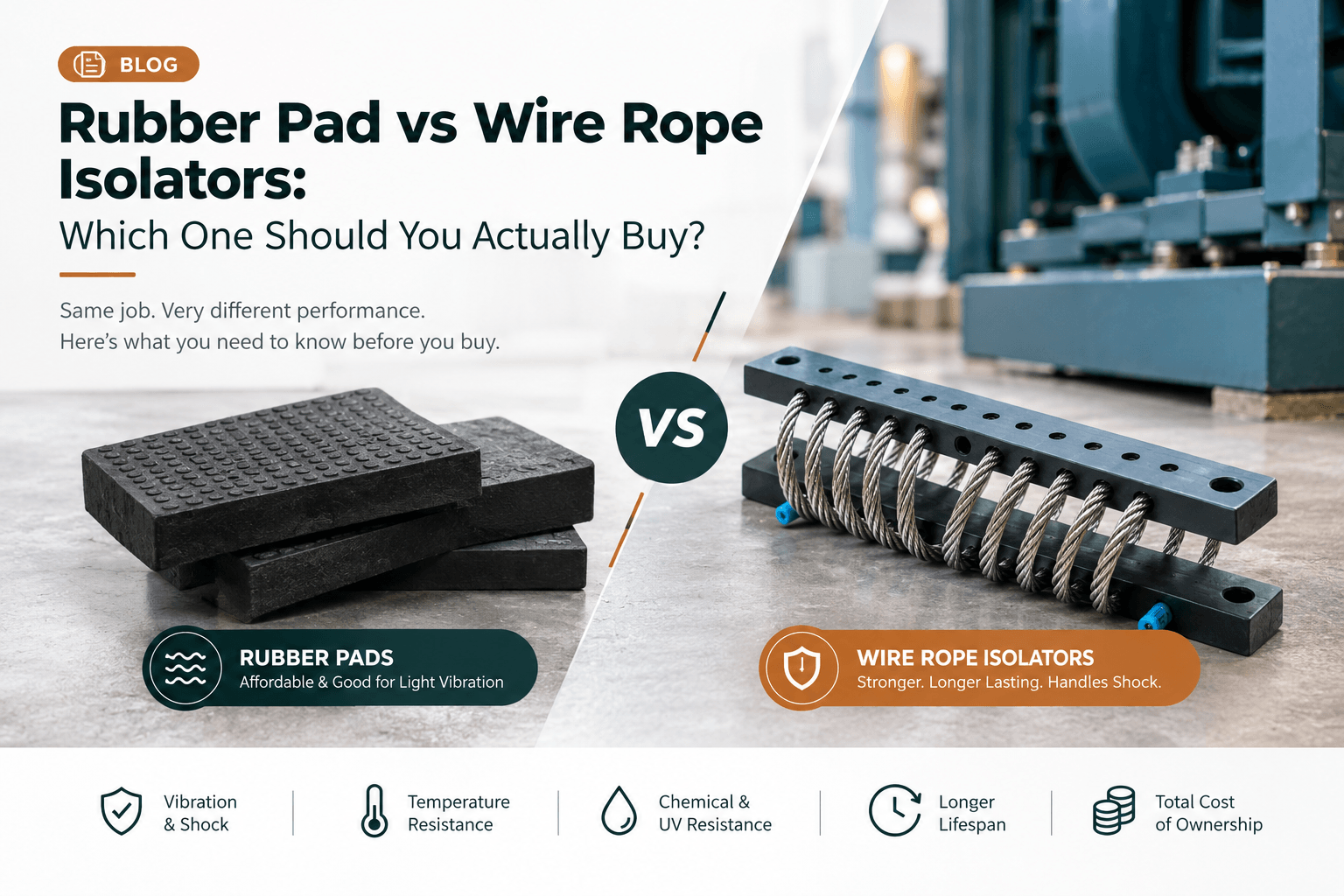
These are moulded blocks or pads of rubber, made from natural rubber, neoprene, or nitrile, sometimes bonded to a metal plate for mounting. You’ll find them under pumps, compressors, fans, and general machinery sitting on a factory floor. They’re everywhere because they’re cheap and easy to get.
They’re genuinely good at soaking up steady, high frequency vibration and cutting down noise.
Wire rope isolators
These look nothing like rubber pads. They’re made of stainless steel wire rope, coiled and held between two metal bars. You’ll find them protecting control panels, generators, electronics cabinets, and equipment that gets moved around or lives outdoors, including defence, railway, and marine gear.
They’re good at absorbing both shock and vibration, surviving harsh environments, and lasting a long time without needing attention.
Head to Head: The Differences That Actually Matter
| Factor | Rubber Pad | Wire Rope Isolator |
|---|---|---|
| Handles steady vibration | Good | Good |
| Handles sudden shock | Weak | Excellent |
| Hot or cold environments | Hardens in cold, softens or degrades in heat | Stays stable in both extremes |
| Oil, chemicals, ozone, UV | Cracks, swells, ages fast | Barely affected, since it’s steel |
| Ageing over time | Compresses and hardens permanently | Very stable, year after year |
| Type of movement absorbed | Mostly up and down, one or two directions | All directions: up and down, sideways, twisting |
| Upfront cost | Low | Higher |
| How often you replace it | Often, especially in tough conditions | Rarely |
| Maintenance | Needs regular checking | Almost none |
If you take one line away from this table, make it this. Rubber wins on price. Wire rope wins on how long it lasts and how much it can take.
The Hidden Cost Nobody Puts on the Purchase Order
This part matters most if you’re the one signing off on the spend.
Say a rubber pad costs ₹300 and needs replacing every eight months in a hot, oily environment. Over five years, that’s roughly seven or eight replacements, so around ₹2,100 to ₹2,400 in pads alone. Now add the labour to swap them each time, the machine downtime while it’s out of service, and the risk of vibration damage to expensive components while the pad was degrading and nobody noticed.
A wire rope isolator might cost ₹2,000 upfront and simply outlast the machine. No repeat orders, no surprise downtime, no calls asking why it’s vibrating again three months after the last replacement.
The cheapest part on the purchase order isn’t always the cheapest part on the balance sheet.
When Rubber Pads Are the Right Choice
We’ll be honest here. Rubber isn’t a bad product, it’s just the wrong product in the wrong place a lot of the time. It’s the right choice when the equipment sits indoors, in a clean, temperature controlled space. It also works when the loads are light and there’s no shock or impact involved, when the main goal is cutting noise rather than surviving harsh conditions, and when budget is tight and replacement isn’t a big deal.
If that’s your situation, don’t overspend on wire rope. Rubber will do the job fine.
When Wire Rope Isolators Are the Right Choice
Reach for wire rope when there’s shock or impact involved, not just steady vibration. It also makes sense when the equipment faces heat, cold, oil, dust, or outdoor exposure, when the equipment itself is expensive or sensitive, such as electronics or control panels, or when downtime is expensive and you can’t afford surprise failures.
A few real world examples where this shows up:
Electronic control panels on a busy shop floor, where every jolt from nearby machinery threatens the wiring inside.
Generator sets and heavy engines, where constant running vibration needs to be absorbed for years without maintenance.
Equipment being transported over rough Indian roads, where potholes deliver shock loads a rubber pad simply wasn’t built for.
Defence, railway, and marine equipment, where failure isn’t an inconvenience. It’s a safety issue.
Common Mistakes Buyers and Engineers Make
Choosing by price or size alone, without actually checking the load weight, is a common one. So is using rubber outdoors or in oily conditions, then blaming poor quality when it cracks in a few months. Other mistakes include using the wrong number of isolators or placing them badly, so the machine leans or sways, picking an isolator that’s too stiff or too soft for the actual load it’s carrying, and skipping the supplier’s technical input and just ordering the standard one.
Quick Decision Guide: 5 Questions to Ask Before You Buy
Save this list and forward it to whoever’s placing the order.
- What’s the total weight of the equipment?
- Is the real problem constant vibration, sudden shock, or both?
- What’s the operating environment: heat, cold, oil, dust, moisture, or outdoors?
- How long should this last before you’re willing to replace it?
- What does one hour of unplanned downtime actually cost you?
If your answers involve shock, harsh conditions, or expensive downtime, wire rope is almost always the better call.
FAQs
Are wire rope isolators always better than rubber?
Not always, just for tougher jobs. For light, clean, indoor use, rubber does the job at a lower cost. Wire rope earns its price when shock, harsh conditions, or long life matter.
Can I replace rubber pads with wire rope isolators on an existing machine?
Usually yes, but the right size and configuration depends on the equipment’s weight and how it’s mounted. It’s worth getting this checked rather than guessing.
How do I know how many isolators I need?
It comes down to the total weight of the equipment and how it’s distributed across the mounting points, not a fixed number that works for every machine.
Do wire rope isolators need maintenance?
Almost none. That’s one of the main reasons people choose them for equipment that’s hard to access or can’t be taken offline often.
Can wire rope isolators be customised for a specific load?
Yes. They can be sized and configured for the exact weight, shock level, and mounting setup of your equipment.
Not Sure Which One Fits Your Machine?
Get a Free Recommendation